8.17.2026
My Feelings for Godzilla
P 128
ゴジラへの想い
My Feelings for Godzilla
川北紘一とゴジラ
Koichi Kawakita and Godzilla
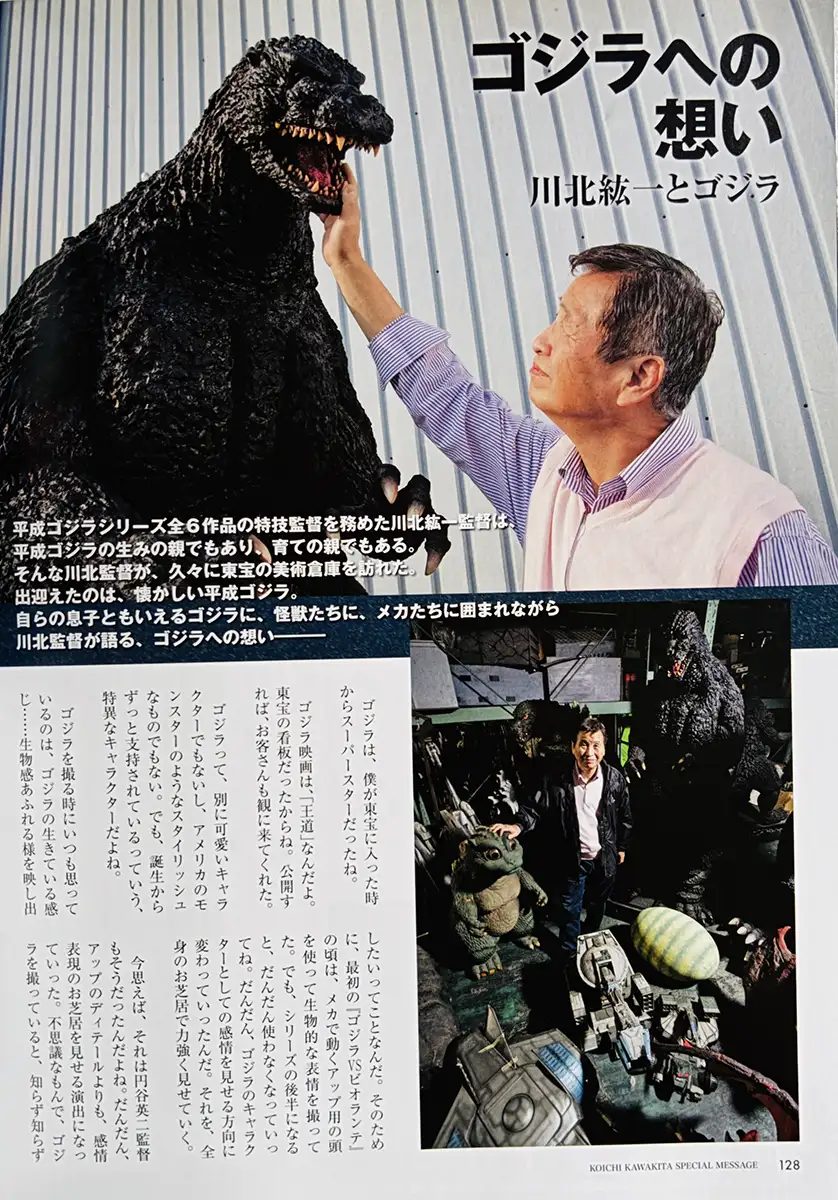
平成ゴジラシリーズ全6作品の特技監督を務めた川北紘一監督は、平成ゴジラの生みの親でもあり、育ての親でもある。
Director Koichi Kawakita, who served as the special effects director for all six films in the Heisei Godzilla series, is both the creator and the nurturer of Heisei Godzilla.
そんな川北監督が、久々に東宝の美術倉庫を訪れた。
Director Kawakita visited Toho’s art warehouse for the first time in a long while.
出迎えたのは、懐かしい平成ゴジラ。
What welcomed me was the nostalgic Heisei Godzilla.
自らの息子ともいえるゴジラに、怪獣たちに、メカたちに囲まれながら川北監督が語る、ゴジラへの想い——
Surrounded by Godzilla—whom he regards almost as a son—as well as the various kaiju and mechs, Director Kawakita speaks about his feelings for Godzilla…
ゴジラは、僕が東宝に入った時からスーパースターだったね。
Godzilla was already a superstar when I joined Toho.
ゴジラ映画は、「王道」なんだよ。東宝の看板だったからね。公開すれば、お客さんも観に来てくれた。
Godzilla movies were the “gold standard.” After all, the franchise was Toho’s flagship property; whenever a new one was released, audiences would turn out to see it.
ゴジラって、別に可愛いキャラクターでもないし、アメリカのモンスターのようなスタイリッシュなものでもない。でも、誕生からずっと支持されているっていう、特異なキャラクターだよね。
Godzilla isn’t exactly a cute character, nor does he have the stylish look of American monsters. Yet, he’s a unique character who has enjoyed enduring support ever since his debut.
ゴジラを撮る時にいつも思っているのは、ゴジラの生きている感じ・・・・・・生物感あふれる様を映し出したいってことなんだ。そのために、最初の『ゴジラビオランテ』の頃は、メカで動くアップ用の頭を使って生物的な表情を撮ってた。でも、シリーズの後半になると、だんだん使わなくなっていってね。だんだん、ゴジラのキャラクターとしての感情を見せる方向に変わっていったんだ。それを、全身のお芝居で力強く見せていく。
When filming Godzilla, my constant aim is to capture a sense of life—to portray him as a truly living, breathing creature. To achieve this, back when we were making “Godzilla vs. Biollante,” I used a mechanically operated head for close-ups to capture organic, lifelike expressions. However, as the series progressed, we gradually stopped using that method. The approach shifted toward conveying Godzilla’s emotions through his character, expressing them powerfully through his full-body performance.
今思えば、それは円谷英二監督もそうだったんだよね。だんだん、アップのディテールよりも、感情表現のお芝居を見せる演出になっていった。不思議なもんで、ゴジラを撮っていると、知らず知らずに踏襲していくんだね・・・・・・。
Come to think of it, that was true for Director Eiji Tsuburaya as well. Over time, the direction shifted away from focusing on close-up details and toward showcasing the acting and emotional expression. It’s a strange thing—when you’re filming Godzilla, you find yourself following in those footsteps without even realizing it…

P 129
撮っていくうちに、ゴジラへの愛情が深まっていったんだ。
As I kept filming, my love for Godzilla deepened.
でも、そうやってゴジラの気持ちを見せていったことで、お客さんがついてきてくれたんじゃないかな。ただ、リアルに見せるだけじゃなくてね。ゴジラを、子供が思わずその強さに憧れるような、そんな存在にできたんじゃないかと思ってる。ゴジラの力強さは、力強さは、僕にとっても魅力なんだ。
But I think that by revealing Godzilla’s feelings in that way, we were able to get the audience on board—it wasn’t just about making him look realistic. I believe we managed to turn Godzilla into the kind of figure whose strength makes children instinctively admire him. That sheer power of Godzilla… it holds a real appeal for me, too.
僕が手がけた平成ゴジラは、キャラクター的にも一貫してたし、6本の作品の中に、始まりから終焉までがあった。『ゴジラデストロイア』で、自分の手がけたゴジラをきれいに終わらせることができて、本当によかったと思うよ。
The Heisei Godzilla series I worked on maintained a consistent characterization, and the six films encompassed the entire arc from beginning to end. I’m truly glad I was able to bring a clean conclusion to the Godzilla I had shaped with “Godzilla vs. Destoroyah.”
僕は、今も仕事でゴジラに関わることが多いけど、やっぱりそれはゴジラへの想いがあるからだと思うよ。それはね・・・・・・好きじゃなきゃできないんだよ。
I’m still frequently involved with Godzilla in my work, and I think that’s ultimately because of the feelings I have for the character. You see… it’s something you simply couldn’t do if you didn’t love it.
やっぱり、6本ゴジラを撮るうちに、愛情が深まっていったんだろうね。
I suppose the affection must have deepened as they made six Godzilla films.
うん、ゴジラが好きなんだな。
Yeah, you really love Godzilla, don’t you?
(平成23年9月25日)
(September 25, 2011)
PROFILE
かわきたこういち
Koichi Kawakita
1942年生まれ。1962年に東宝に入社し、「ウルトラマンA』(1972年)で特技監督デビュー。「ゴジラVSビオランテ」から「モスラ2海底の大決戦」までの東宝特撮映画で特技監督を務めた。2003年に制作会社「ドリーム・プラネット・ジャパン」を設立し、超星神シリーズの特撮などを手がける。
Born in 1942. He joined Toho in 1962 and made his debut as a special effects director with “Ultraman Ace” (1972). He served as the special effects director for Toho tokusatsu films ranging from “Godzilla vs. Biollante” to “Rebirth of Mothra II”. In 2003, he established the production company Dream Planet Japan, where he worked on special effects for projects such as the “Chouseishin” series.
Source: Heisei Godzilla Perfection, p 128-9